
Human Flower Project
Change is Language
By julie on March 22nd, 2022 in Uncategorized
Change Is Language
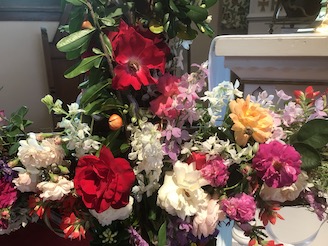
La Grange, Texas, 2020
The last message here, nearly nine years ago, turned to poet David Ignatow to disclose a season of withering. At the time, we had no other language for that but neglect.
Then in August 2019, our webhost shut down. People who still checked on Human Flower Project from time to time notified us that it had vanished.
Once we contacted the hosting company six months thereafter and were told nothing could be retrieved, the language of neglect was transposed to regret. We’d published for eight years, not just our own efforts but the works of enormously talented others — writers, photographers, researchers — all of whom had become friends.
There were notebooks left, stray files, and some very homely pdfs of every page created one tedious, though prescient, summer. Could these somehow be transformed into HTML and re-presented through another webhost without agony? Some good advisors only shuddered.
WayBackMachine is the brainchild of Brewster Kahle and Bruce Gilliat who, collecting backward, were actually looking into the future when, for a thousand reasons, information once posted on the web could be – would be – lost. How our humble blog made it into this magnificent digital library is a mystery, one for which we are amazed and profoundly grateful.
2022 arrived with incentive for resolutions. We decided to pour out the woeful story to a new friend, computer genius Greg W. (abbreviated so as not to crush him with more requests for help). Ever curious and never one to give up, Greg began poking around in whatever manner wizards do. He came upon waybackmachine and discovered there hundreds of HFP webpages that had been archived.
With Greg’s help, and lots of further assistance from Mohamed at waybackmachine downloader, we are able to revive Human Flower Project. The search feature is functioning but other elements may not have “translated” into wordpress smoothly. Perhaps in time.
Yes, Mr. Ignatow. Change indeed is language, in our case very literally. We’re slowly learning the language of WordPress.
And in the years since ignoring the site we’ve been increasingly devoted to studying Spanish. That challenge has involved a good deal of withering, also new friends, new growths. Human Flower Project has always aspired to be international. As we celebrate the spring equinox and the re-publication HFP, we hope to grow toward bilingualism.
Es decir, Spanish-speaking folklorists, gardeners, horticulturalists, we especially welcome you, as readers and as collaborators.
Folcloristas, antropólogos, jardineros, horticultores, les damos la bienvenida especialmente a ustedes, como lectores y como colaboradores.
¡Adelante!
Unless Change Is A Language
By julie on March 30th, 2013 in Uncategorized
Unless Change Is a Language
Plants and flowers have their colors
and shapes. They sway in the wind yet
their roots support them
and they live to grow.
If they wither
it is not said
unless change is language.
—David Ignatow
Mandorla Intersecting Worlds
By julie on July 11th, 2012 in Uncategorized
Mandorla: Intersecting Worlds
With a tragedy in Russia, mourners and their florists turn to an old figure of Eastern Orthodox iconography, shaped like a seed.
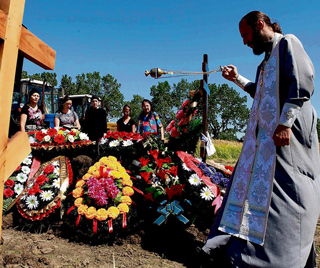
A Russian Orthodox priest blesses graves outside Krymsk.
Overnight floods in Krymsk, a southern Russia city east of the Black Sea, killed at least 172 people early Sunday morning. There had been no warning, even though authorities later admitted having known by 10 p.m. Saturday that heavy rains threatened to inundate the town.
Some of the survivors (more than 25,000 lost their homes and belongings) say they believe that along with flooded natural waterways, more water was actually released from a reservoir above the city, “a theory rebutted by scientists from Russia’s environmental monitoring service, who said Friday’s rains swelled nearby rivers with the equivalent of six months’ average precipitation.”
Recriminations have been mounting. And so have floral tributes to the dead. Thanks to Craig Cramer of Ellis Hollow for alerting us to these striking images taken in a makeshift graveyard outside Krymsk.
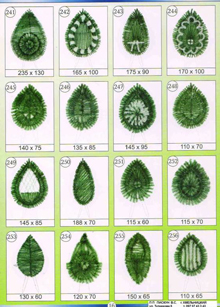 A Ukrainian florist advertises various designs for wreaths, most of them variations on the tear-drop form of the mandorla.
How different these sympathy arrangements are from the circular wreaths and sprays we’re accustomed to. All morning we’ve been searching for clues as to their distinctive shape. Egg? Seed? Womb? Teardrop?
After browsing through Russian and Ukrainian florists websites, we’re still not certain why this form of tribute is such a consistent floral presence at funerals in the region. We’ve read that even-numbered flowers are preferred (even required) at times of mourning and that yellow blooms are unwelcome at happy or sad occasions alike.
Having read up on Russian funeral customs and dipped into church symbolism, we’ve come to think that the massive oval-shaped arrangements follow an iconic shape in Eastern Orthodoxy—the mandorla.
This encapsulating form recurs in Christian imagery, a kind of radiant bubble that surrounds divine figures when they appear to humankind.
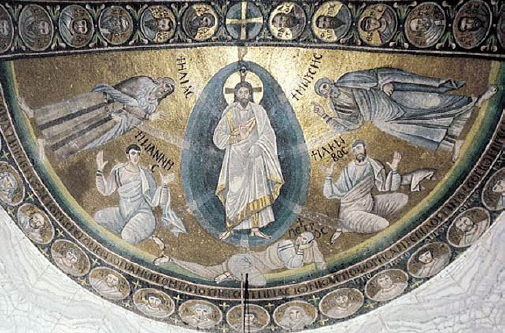
One of the earliest such images is this Apse mosaic of the Transfiguration, St. Catherine’s Monastery, Mount Sinai, c. 550-565
“The term refers to the almond like shape: “mandorla” means almond nut in Italian. In icons of the Eastern Orthodox Church, the mandorla is used to depict sacred moments which transcend time and space, such as the Resurrection, Transfiguration, and the Dormition of the Theotokos.”
In Pythagorean symbolism and pre-Christian art, the mandorla shape was conceived as two intersecting circles, alluding again to a kind of “eclipse,” when two different dimensions coalesce; momentarily, there’s a keyhole that makes it possible to see a more essential reality than we know in everyday life.
These pendulous wreaths, often fashioned with concentric rings of flower-color, remind us of the luminous cloud around our Lady of Guadalupe, a form that both protects and projects the power residing inside.
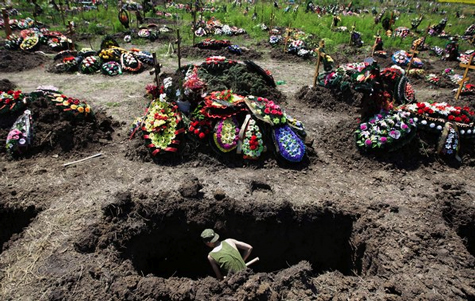
A soldier digs a grave outside Krymsk, Russia. More than 170 residents of the town died in early morning floods Sunday July 8.
Photo: Sergey Ponomarev, for AP
The intersection of opposites certainly comes through in Sergey Ponomarev’s astonishing photo from the Krymsk cemetery. A pale young man (or is it a girl?) shovels inside a grave, a black block surrounded with mud, while on the ground above scores of the bright egg-shaped arrangements lie across fresh gravemounds; all the way to the horizon, they shine back at the sky.
Royalish Flower Seed
By julie on July 5th, 2012 in Uncategorized
Royalish Flower Seed
Seed from some of the plants grown at Buckingham Palace are now on sale, but will their royal connections get them across international borders?
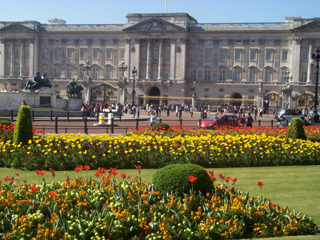
The gardens at Buckingham Palace
You may not be royalty, but you too can grow poppies (even we have managed that). Nobody curtsey for you recently? Stand tall, and grow the same upright ginger as blooms at Buckingham Palace.
The BBC reports that 11 plant varieties from among the more than 350 flowers that grow there can be yours.
During the Hampton Court Flower Show, running until Sunday, the seed will be for sale at the Plant Heritage Seed Shop, for a minimum £1 donation to “the charity.” (which we take to mean Plant Heritage, not the British monarchy, which seems to be solvent).
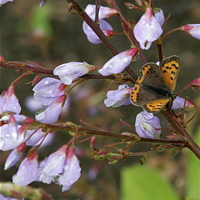 Desmodium elegans
Poppies (Papaver spicatum), upright ginger ( Saruma henryi), and tilifolium (Desmodium elegans) will be among the 11 seed varieties.
England is renowned for its gardening prowess, a combination of acquisitiveness (a.k.a. colonialism), labour, and fairly ideal growing conditions. According to the BBC article, “The UK’s temperate climate allows gardeners this variety, ranging from shrubs and heather to exotic, sub-tropical varieties of plants and flowers.
And this ability to grow almost anything makes horticulture very much a part of British identity, said German-born Wolfgang Stuppy, seed morphologist at Kew’s Millennium Seed Bank project, which aims to collect and conserve 25% of the world’s seeds by 2020.”
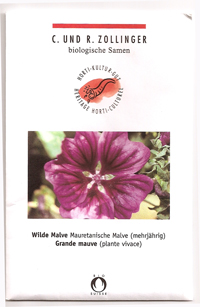 Swiss flower seed brought to us by a friend
As for the seed selections now for sale, “I’m sure they’ll be popular in the Jubilee year because a lot of people come from overseas,” said Janet Wright of Plant Heritage. “They obviously can’t take plants home but they’re allowed to take seeds.”
Actually, customs regulations are a whole lot trickier than that. In some cases it IS permissible to bring plants over international borders, and in others seeds are forbidden. Here are just references to the mind-snarling regulations in the U.S., the U.K. and Australia.
In every case where we confessed to customs officials that we were carrying flower seed packets, they’ve been confiscated. We welcome hearing from readers (including anonymous ones) about their experiences traveling with flower seed or having to leave it at the border.
Aung San Suu Kyis Gentle Correction
By julie on July 1st, 2012 in Uncategorized
A Gentle Correction
About 10 days ago, we cited a New York Times article explaining why Burma’s human rights leader wears flowers in her hair. She kindly corrected us both, us all.
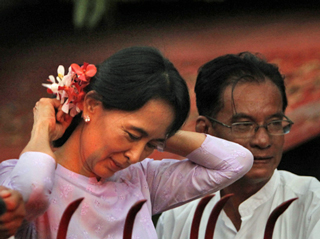
Aung San Suu Kyi pinned a supporter’s flowers in her hair on the day she was released from house arrest.
While visiting France in late June, Burmese human rights leader Aung San Suu Kyi, who recently had accepted her Nobel Peace Prize, remarked on the customary flowers in her hair. The New York Times had reported that she wore them in memory of her late father, who would put flowers in her hair. HFP seized on this information and passed it along.
But Aung San Suu Kyi corrected that notion recently while visiting France.
“You see, I was only two when my father died,” she said. “And at that time, I had no hair! In Burma we believed if you shaved children’s hair, it grows back thick and long. And my hair was always shaved, so it’s only a myth that he placed flowers there… but I’m very touched people think he did.
“The reason why I wear flowers in my hair is actually because my mother used to do so. This was very much a Burmese tradition. But these days Burmese girls have started cutting their hair short so they no longer wear flowers. And on top of it, they don’t know how or have great difficulty doing it. Even my personal assistant—who has short hair—doesn’t know how to help me.”