
Human Flower Project
Orrington, MAINE USA

Murrieta, CALIFORNIA USA

Princeton, MAINE USA
Sunday, April 29, 2007
Ginza’s Pricey Streets
To begin Golden Week, tulip petals carpet a main thoroughfare in Tokyo’s costly shopping district.
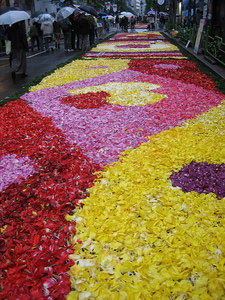 Tulip carpets in
the Ginza district
Tokyo, April 2006
Photo: Trina Chow
Today begins a peppering of holidays in Japan, four in a row, that the Japanese wisely round off as Golden Week. This is Showa Day, in homage to former Emperor Hirohito, born April 29, 1901. May 3 will be Constitution Day, and May 5, Children’s Day. The fourth occasion? We’ve discovered that under Japanese law “a day that falls between two national holidays (is declared) a national holiday” also. Now here’s a forward-thinking piece of legislation. May 4th, thus, will be “Greenery Day.”
In the Ginza district of Tokyo, widely referred to as “the most exclusive and expensive shopping area in Japan,” they really get down on Showa Day, covering Miyuki-dori Street with carpets of tulip petals. The flowers “appear on the 300-meter long avenue from Nishi-ginza dori (Sotobori-dori) to Ginza-dori. 200,000 tulips will arrive from Toyama prefecture early in the morning.” Seems to us that the colors look all the more saturated within the city’s architectural canyons. You can read more about the Ginza district, some of its landmarks and swankiness here.
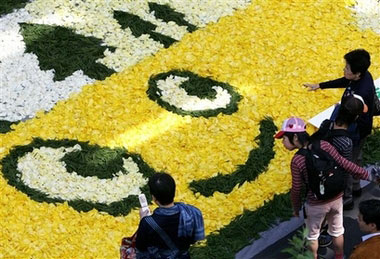
Sightseers take in flower covered Miyuk-dori St., 2007
Photo: Shizuo Kambayashi, for AP
“Showa” is the official name for Emperor Hirohito’s reign—1926-1989. Since he presided over Japan during World War II, Hirohito’s legacy is fraught with international tensions. Maybe that’s why, after his death, “Showa Day” was downplayed and the more politically neutral “Greenery Day” played up. Ah yes—where directness poses a threat, plants and flowers often are stuffed into the breach.
The tulip petal carpets along Miyuk-dori Street of course serve a balder purpose also: It’s a holiday, people. Bring your wallet and come on down!