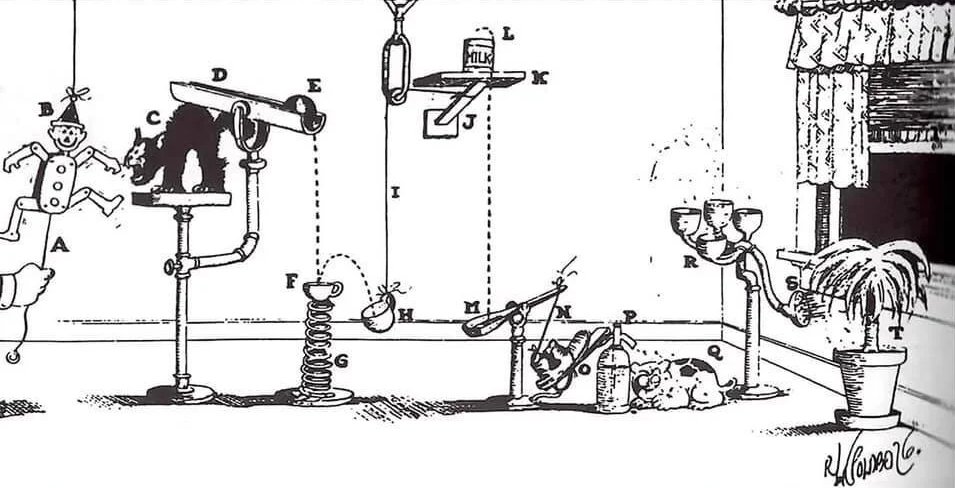
Self-Watering Palm Tree, by Rube Goldberg
The best route isn’t always direct, especially when it comes to pollination.
Thank you to Ernesto Sandoval, curator at UC Davis’s Greenhouses, for sending this news of bird/flower symbiosis.
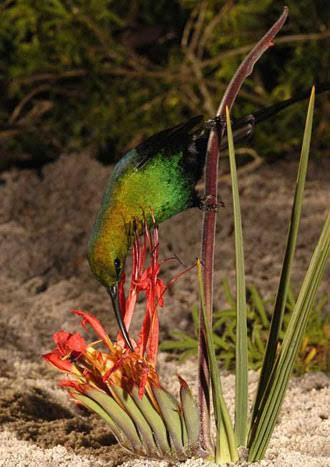
Babiana ringens has a “rat tail” perch for its ideal pollinator, the malachite sunbird.
Photo: Cameron Ewart-Smith, for National Geographic
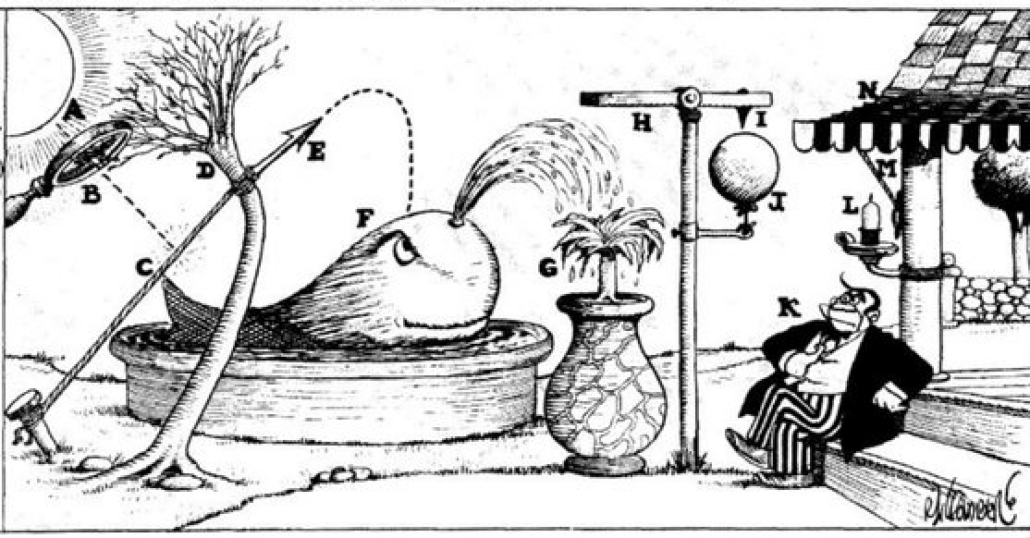
Babiana ringens, a plant known in its native South Africa as “rat tail,” must have been designed by Rube Goldberg. A hero of ours, Goldberg dreamed up maximally inefficient machines for simple tasks—the match lights the end of the string, which burns through the base of the stick, which topples over to the right, landing on a tiny catapult, which pitches a rubber ball in the air…and 17 steps later the doorbell clangs.
Now take a look at Babiana ringens.
In a newly published study, botanists in Canada and South Africa conclude that the plant’s “rat tail” spike is actually a settee for malachite sunbirds, “making it easier for them to drink nectar from the plant’s peculiar ground-level flowers.”
The sunbird, with a notably long curved beak, is this plant’s main pollinator. “When a bird assumes the upside-down position, its breast is brushed with pollen. The bird then spreads the pollen to other B. ringens.” After the researchers removed the perch from some plants, sunbirds were less inclined to drop by, male sunbirds especially—“possibly because they have much longer tail feathers, which could interfere with ground landings and takeoffs.”
Only Rube Goldberg could have fashioned a plant whose survival depends, in part, on the unimpeded male sunbird tail feather
…Rube or divinity.
That’s the outlook of creationist Frank Sherwin. Sherwin describes the bucket orchid’s means of pollination, all twists, dunks, traps and turns. The orchid relies on collaboration (deception might be truer) of the euglossine bee, a perfumer of the apian world.
“The bucket orchid does not produce nectar that usually attracts insects. A male euglossine bee is instead attracted to the bucket orchid by its secretion of an aromatic fluid composed mostly of compounds called esters.” Then begins the Rube Goldberg sequence:
“The bee lands and falls into the fluid of the bucket orchid. Brushes on the insect’s foreleg pick up the chemicals that are then stored inside their swollen hind leg (tibia). The orchid’s downward-facing guard hairs prevent the struggling bee from climbing out except at a narrow spout. This spout just happens to be designed with small knobs that provide footing for the insect so it can climb up!”
And that’s not all: Inside the knobby spot, the flower clutches. “As the bee tries to escape, the flower holds it and applies glue from a structure called the viscidium.” Sacs of pollen grains then can attach to the glue. but, of course, glue needs to dry. The bucket orchid holds the bee trapped inside for 45 minutes more, then releases it – to fly off with its loaded vest and pollinate another flower.
This National Geographic video of the process, narrated by a seductive “orchid” voice (not the voice of God), boggles the mind.
So, in a very different manner, does the Purdue University Engineering team’s 2011 tour de force. They broke the Guinness Book of World Records in 2011 for their 244-step Rube Goldberg machine to water a “flower.”
All proof that efficiency is overrated. Take that, Elon Musk, take ALL of that!


Leave a Reply