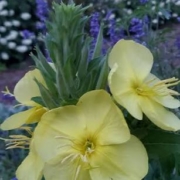
Nicodemus: Evening Primrose
Evening primroses can open the Bible, kick off a party or alleviate PMS. ‘How can this be?’
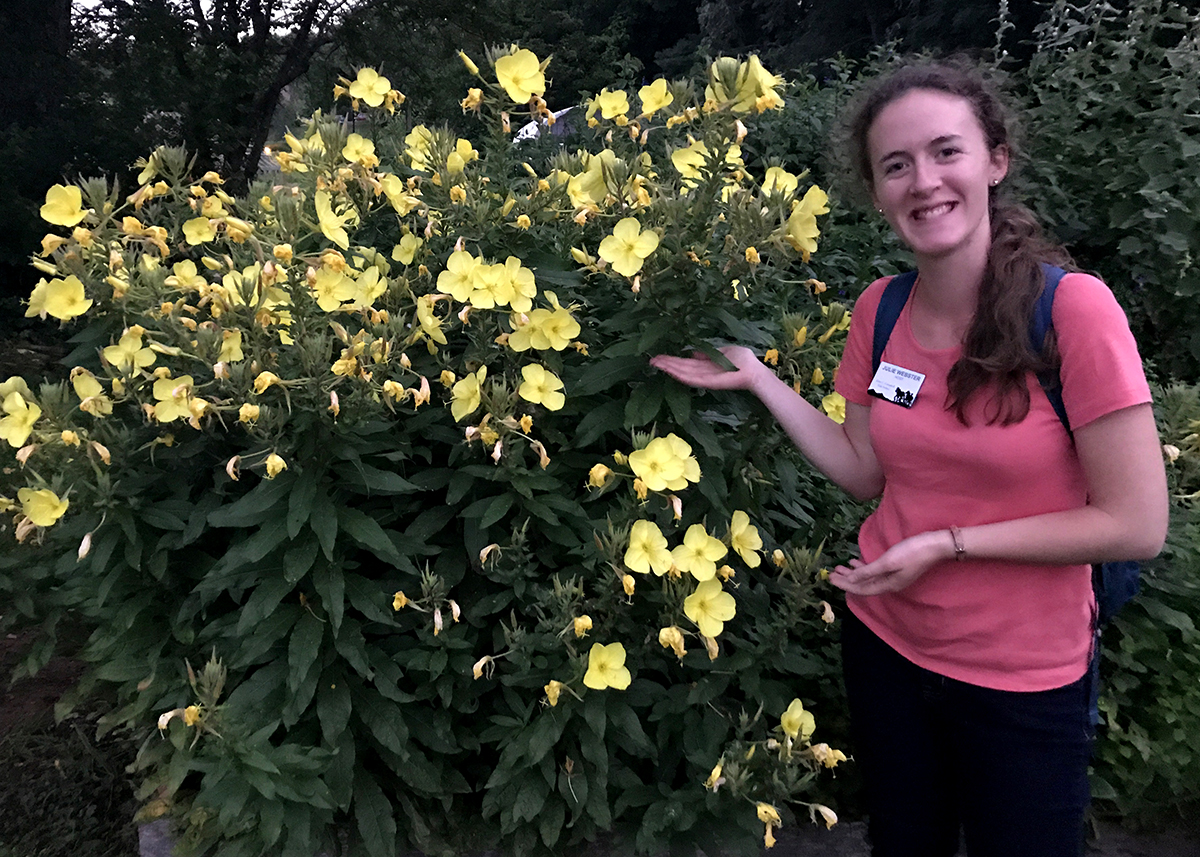
At a Tina James Magic Primrose party
Photo: John C. Campbell Folk School
Evening primrose, Oenothera, comes into bloom in early summer across much of the central U.S. and flowers on for weeks. As its name gives away, it’s one of those fascinating night-blooming plants favored by moths and bats. Attracting pollinators mainly by scent, these flowers can dispense with bright colors; evening primrose and most of its fellow “owls” bloom in shades of white and yellow, the better to glow.
In parts of the U.S, notably the South. evening primrose is known as “Nicodemus flower.” A Sunday school group in Knoxville, Tennessee, “gathered at the home of Maggie and Sid Rutherford to watch the blooming. The Nicodemus flower has special meaning… It was named for Nicodemus in the Bible. Nicodemus only met with Jesus at night.”
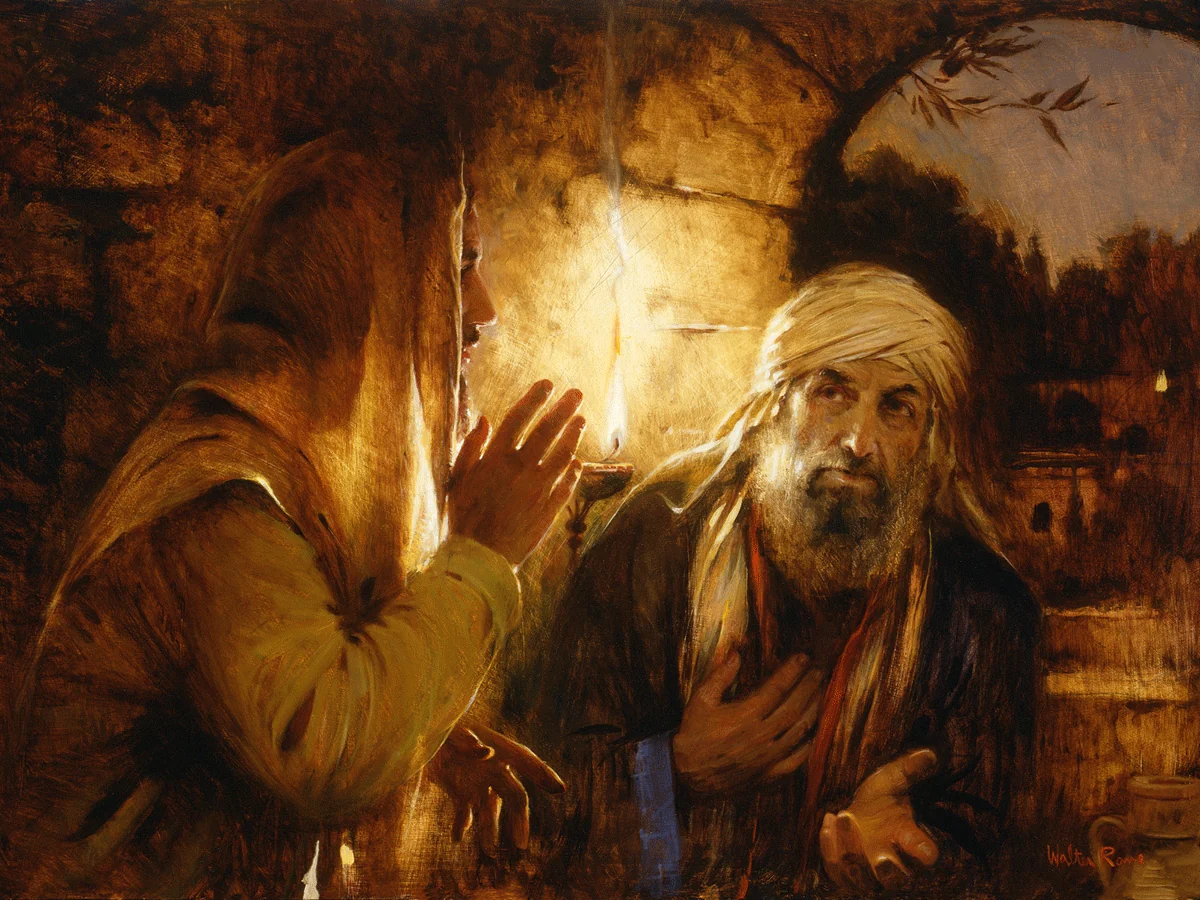
Nicodemus meeting with Jesus by night
Painting: Walter Rane
A Pharisee, Nicodemus had status and clout, unlike most of Jesus’s followers, yet he was intrigued.
“This man came to Jesus by night because he was afraid of being seen with him in daylight and said to him, ‘Rabbi, we know that you are a teacher who has come from God, for no one can do these signs that you do unless God is with him.’ Jesus answered him, ‘Truly, truly, I say to you, unless one is born again he cannot see the kingdom of God.’
“Nicodemus asked, ‘How can a man be born when he is old? Can he enter a second time into his mother’s womb and be born?’
Jesus answered, ‘Truly, truly, I say to you, unless one is born of water and the Spirit, he cannot enter the kingdom of God. That which is born of the flesh is flesh, and that which is born of the Spirit is spirit. Do not marvel that I said to you, ‘You must be born again.’ The wind blows where it wishes, and you hear its sound, but you do not know where it comes from or goes. So it is with everyone who is born of the Spirit’ ”
“’How can this be?’ Nicodemus asked.”(John 3: 1-9)
Very good question to ask of miracle-workers and, it turns out, of flowers also.
Oenothera biennis, the variety best known as evening primrose, “is a weedy species that favors disturbed environments. It has been introduced and become established on all continents except Antarctica.”
Sounds a lot like Christianity. Except there are eight Christian churches in Antarctica.

Mary Stutz enjoys her evening primrose at nighfall in Dover, OH
Photo: Times Reporter
The late George Rooks, fisherman and columnist for The Bethel Journal, wrote that on his Fox Farm near Owensville, Ohio, evening primrose abounded, “… starting to open at 8:20 p.m. This is a very exciting thing to see.” He learned from “a lady” in his community the story of Nicodemus: “how he went to see Jesus and didn’t want anybody to see him. Now I am sure you Bible scholars already knew this, but I learned something new.” George, who presumably was fishing Sunday mornings, generously supplied directions to Fox Farm so others could witness the sight.
Sorry to say, George is gone. We wonder if the evening primroses still bloom on Fox Farm.
He had tapped into an enticing custom that we hope lives on: to gather at dusk as night-bloomers open. People who work in offices all day long may take special pleasure in moon gardens of datura, four o’clocks, and evening primrose. After sundown, the fragrant blossoms are cooling as a martini, and better in the long run for an agitated mind.
Tina James, who hosted The Good Earth Garden show for Maryland Public TV in the 1980s, was a notable hostess of “primrose parties”. In July visitors can see for themselves the Tina James Magic Primrose unfurl some evening at the John C. Campbell Folk School, and there’s at least one source to buy seed too (that is if your ‘disturbed environment” could benefit some something “weedy”).
And this piece from the Blount County (Tennessee) Daily Times reports on a more recent gathering :

Time lapse photos of evening primrose.
Photos: Montana Naturalist
“A group of Friendsville neighbors sat in a row, preparing to watch a spectacular show that happens only in the evenings, only at this time of year. The six adults chatted before the show began. Four children, ranging in age from 2 1/2 to 9, ran through the yard at play until the diminishing light of day brought the stars to the stage.
“With a slight shudder, the flowers of the night-blooming evening primrose, also called the Nicodemus flower, began opening their petals.
“The children — Isaac Gonzalez, 9, and siblings Ellie Effler, 8, Seth Effler, 6, and Thomas Effler, 2 1/2 — and their parents, Adam and Janean Johnson and Jordan and Emily Effler, watched in awe with Dave and Betty Staley as the tight buds opened before their eyes to reveal the full, yellow blooms, one by one.”
This source precisely reports: “Blooms are 2⁄3 open within 10 seconds or less, and fully open within 1-2 minutes! Blooming lasts 5-6 weeks or more.” It adds that evening primroses also make good cut flowers, lasting up to a week. And if your summer evenings, like ours, are wracked by mosquitos, you can bring the flowers indoors, dim the lights and still enjoy a viewing party.

Dutch botanist Hugo de Vries (1848-1935) developed his theories of genetics studying the mutation-prone evening primrose.
Painting: Therese Schwartz, 1918, via Wikipedia
From other vantage points, the evening primrose looks less like a disciple or a party animal. It was the species that absorbed the mind of geneticist Hugo de Vries, due to its proclivity for mutations. And primrose oil gets popped in capsule form to soothe hot flashes (though there’s not much scientific evidence to recommend it…yet).
With the Human Flower Project we’re continually enchanted by floral insignia, but Oenothera biennis reveals a unsettled and unsettling perspective. Domineering as it tries to be, human culture can never make anything in the natural world entirely its own. No human use, metaphor, or name will have the last word for a river, a star, a flower. It’s not that human culture is so endlessly good at exploitation. It’s that the evening primrose, in its anchored vitality, exceeds all our claims.
How did a clandestine revelation from the Gospels become the occasion for a backyard summer party?
“The wind blows where it wishes, and you hear its sound, but you do not know where it comes from or goes.”