The improbable hero of Orczy’s adventure novel took cover behind a common roadside weed.
 Leslie Howard and Merle Oberon
Which side of the French Revolution (the 1789 one, we mean) are you on?
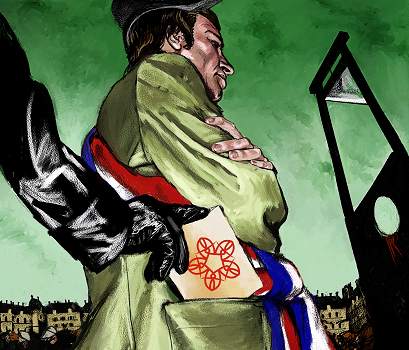
The Scarlet Pimpernel delivers a message
Drawing: Rachel Perkins
In the anti-monarchical U.S., we tend to side with our fellow Revolutionaries, acknowledging that sometimes a few heads must roll in the cause of “Liberte’, Fraternite’, Egalite.’” But in the position of a Hungarian Baroness, as was Emmuska Orczy, one might view things differently. Orczy wrote The Scarlet Pimpernel and, after a dozen rejections, managed to get her story published.
It’s the tale of an 18th century London dandy named Sir Percy Blakeney, his rich boy friends, and their little fraternity, called The League of the Scarlet Pimpernel. To dull-witted observers, they appear a bunch of guys with lacy handkerchiefs who pass the time playing poker and powdering their wigs. Actually, they’re brave souls who are rescuing their fellow aristocrats from the guillotine in France.
Here, as in so many other instances, flowers serve as distractions, red herrings, if you will. For under the sign of this unassuming wildflower, the counterrevolutionaries’ work goes undetected. Even Sir Percy’s wife Marguerite never suspects.
“No one had seen these mysterious Englishmen; as for their leader, he was never spoken of, save with a superstitious shudder. Citoyen Foucquier-Tinville would in the course of the day receive a scrap of paper from some mysterious source; sometimes he would find it in the pocket of his coat, at others it would be handed to him by someone in the crowd, whilst he was on his way to the sitting of the Committee of Public Safety. The paper always contained a brief notice that the band of meddlesome Englishmen were at work, and it was always signed with a device drawn in red–a little star-shaped flower, which we in England call the Scarlet Pimpernel.” Soon enough, those ruffian citoyens would learn that another group of bluebloods had escaped the blade.
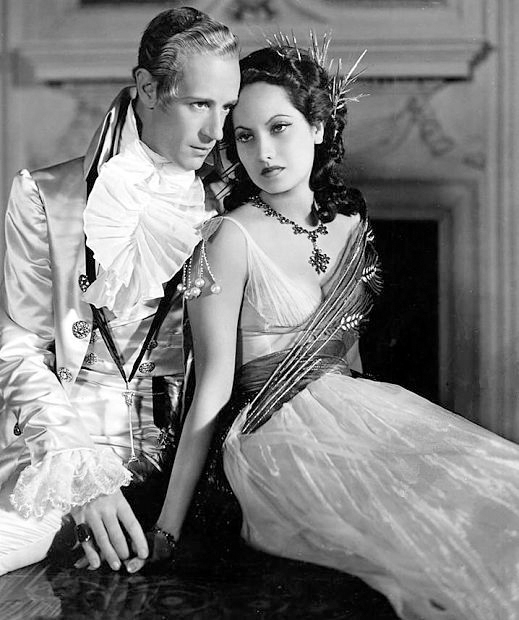
Leslie Howard and Merle Oberon in the Scarlet Pimpernel (1934)
Photo: Photoplay
Scarlet pimpernel, Anagallis arvensis, is a member of the primrose family, a low-growing annual that self seeds in thin soils. “Even in bright weather, the flowers are only open for a comparatively short time – never opening until between eight and nine in the morning and shutting up before three o’clock in the afternoon,” like the league of lords, pretty much unnoticed. Due to this habit, Anagallis arvensis also goes by the alias “Poor Man’s Hourglass.”
If you don’t know the book, you may read it on line now. If you’re a fan of Leslie Howard, catch the 1934 film version, with Merle Oberon as Marguerite. There have been, actually, many stagings of this story, one with Jane Seymour in her pre-suede days. Here are links to an old radio show of The Scarlet Pimpernel and a recent musical.
A number of commentators have pointed out that Orczy’s tale was the basis for many fictional heroes who, overcome by noblesse oblige, used their foppishness as a disguise while battling undercover for the public good. Think Zorro and, of course, Batman. As Bruce Wayne, he seems to stand around in an ascot all day, sipping brandy by the fireplace. Actually, he’s dying to strip off that smoking jacket and put on a big belt of hammers and ray guns.
No matter what side of the revolution you’re on, you will enjoy this magnificent tribute to the scarlet pimpernel flower, by Paul James.

Anagallis arvensis, in the wild
Photo: Paul James
“As wild flowers go it is not rare, though it is not found in abundance in my locality (the UK). It appears to thrive happily on ‘waste places’ and sandy locations, but here it seems happy to grow and reproduce on calcareous soils, overlaying limestone rock, and appears to relish my driveway which is surfaced with compact limestone gravel. Diminutive it may be, though not the smallest by any means, and is easily overlooked.”
Precisely.
(Originally published: HFP January 17, 2006)


Leave a Reply