There are places in perpetual bloom. Take a look and consider if bliss might be blinding.
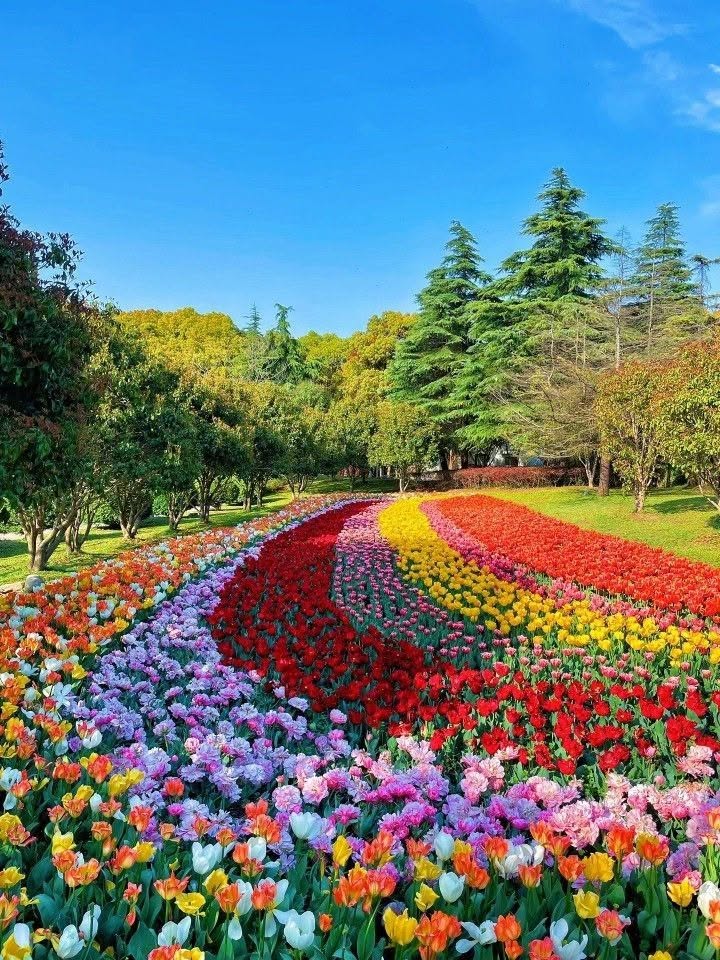

Worthy of the title City of Eternal Spring, Da Lat Vietnam. Photo: Joyful Vietnam Travel Post
It’s a slogan tried and if not quite true, plausible enough. And enticing, to be sure.
“The City of Eternal Spring” brings snowbirds south to San Miguel de Allende, Mexico. It beckons retirees whose bones ache in January and hope never to scrape another windshield. A time share in San Diego or full-fledged flight to the Canary Islands — “Eternal Spring” is a promise of non-stop flowers, too.
As autumn, our favorite season, has arrived in Kentucky, we wondered about those spots around the globe that boast continual brightness. Do they stake their claim on flowers?
Many do. Medellin, Colombia, boasts its stupendous Feria de Flores, borne on the shoulders of the region’s famed silleteros. Cuernavaca, long the retreat of the wealthy capitalinos, claims that geographer Alexander von Humboldt named it “The City of Eternal Spring” two centuries ago and has hung its tourist sector on that alluring title ever since. (“Eternal” is quite a stretch, considering that Humboldt arrived in April).

The giant Dounan Flower Market, Kuning, China.
Photo: Top China Travel
Kunming, China, also touts its climate. Since its immense flower expo takes place in September, Kunming make a stronger care for year-round ”springtime.” Kunming is actually the Keukenhof of China, its gigantic Dounan Flower Market covering three square miles. These images of jacarandas in bloom across the city are pretty astonishing, but, hey, they flower in April.
April does not equal Eternity.
One astute contributor to reddit pointed out that “eternal spring” could describe the climate of “basically any tropical city between 1500m and 2000m of elevation.” That includes a lot of places: Kandy, Sri Lanka; Antigua, Guatemala; Baguio, Philippines; Addis Ababa, Ethiopia….Our sisters and brothers at Wikipedia have different criteria, as their list includes cities at far lower elevations, like Arica, Chile, and Cidra, Puerto Rico..
Here’s yet another roster of Eternal Springers.
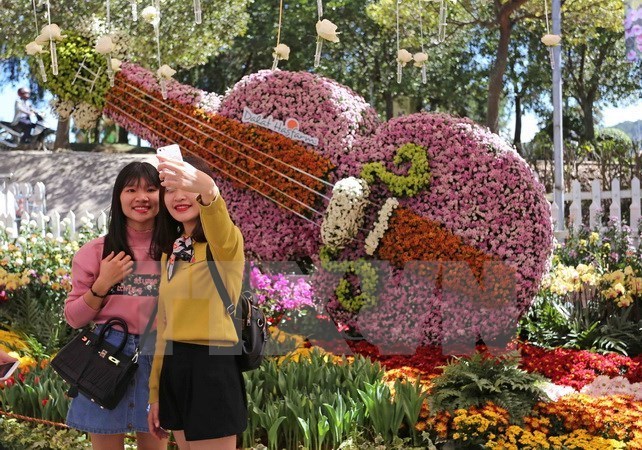
Posing with a floral bass violin at the Da Lat Flower Festival.
Photo: Vietnam Tourism
One place that seems especially deserving of this title “City of Eternal Spring” is Da Lat, Vietnam. Indeed, it has a flower festival that runs for an entire month. No, not in April. December!
It’s one thing for city crews intensively to plant flower beds and arrange displays for a festival, but quite another for there to be local species that bloom year round. Here’s where Da Lat seems to earn its nickname. This album focuses on the city’s flowering trees, varieties that bloom throughout the year,
We know that certain plants, — apple trees, peonies, hyacinths, snowdrops – require a stretch of cold in order to flower. Without a cold winter, bearded iris may fail to bloom at all.
But what effect does “Eternal Spring” have on human consciousness?
Can the sap of erotic desire rise indefinitely, 12 months of the year? Does the capacity for expectation disappear and even the enjoyment of flowers grow dull?
We haven’t found good answers to these questions.
This extensive study tracks the influences of gravitational and geomagnetic forces as well as changes of seasons on the human brain. The authors found “that variation in the intensity and duration of light, along with variability in temperature, has an association with human mood and behavior. The clinical manifestation of this effect can be observed in SAD.” Seasonal Affective Disorder – a melancholy state – caused by lack of sunlight.
“The reduced intensity and duration of light during the winter months are associated with lower mood, sometimes enough to be classified as depression, with a higher probability of this effect in women.”
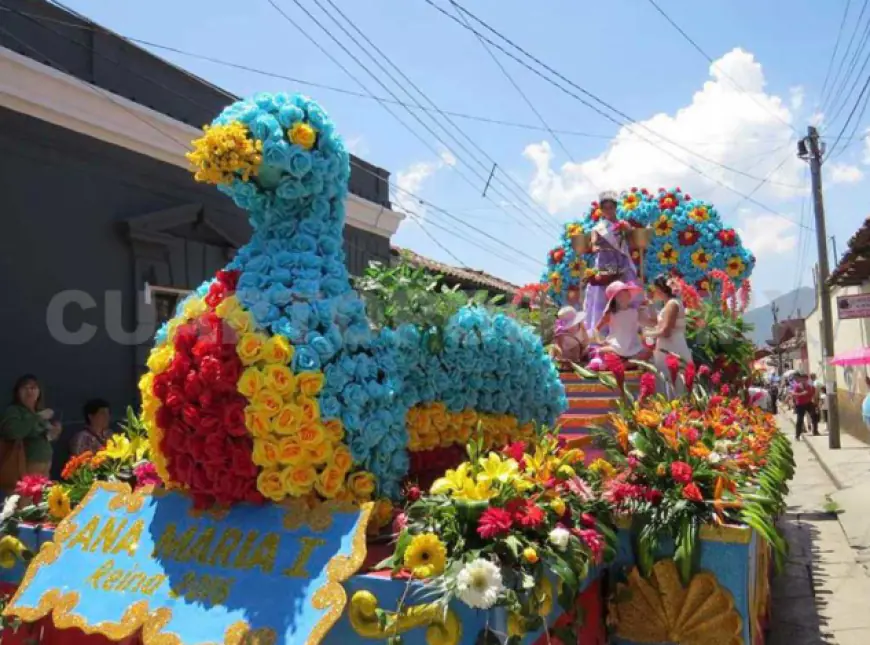
A float in Cuernavaca’s floral parade.
Photo: FbFeria
We lived in Texas for several decades and experienced this effect of SAD in the summertime. Over the years, as summers intensified, we increasingly isolated indoors June to September. The Texas sun was too much to bear, but the lack of sunlight took its toll.
The entire paper is worth reading. We were surprised by several details – for example the rarity of seasonal affective disorder among “the native people of Lapps, Finland or the Icelanders of Canada.” The authors can’t explain it, surmising that “genetic adaptations” might be the reason.
Actually, we found this anecdotal account from blogger Paige Poole, a native of the U.S. living in Colombia, far more fascinating.
Paige writes of her own adjustment to a land without seasons, “In the beginning (I arrived in January 2008,) I didn’t really notice it a lot. Yes, it was “warm” for January, but it was still cool; I was still wearing sweatshirts, sweaters, and jeans. Come February, I still hadn’t thought too much about it. However, come May/June, a weird feeling came over me.”
 Looking at friends’ photographs and posts from back home, “I realized people were enjoying the end of spring and beginning of summer. How was it, then, that I was still stuck in a fall/winter climate? To me, it seemed as if time had left me behind, while the rest of the world kept moving along….” Paige describes this sensation as feeling “frozen in time.”
“One co-worker told me this is why he thinks most foreigners only last about 5 years here” in Colombia, she adds. Another colleague expressed concern bordering on alarm. This friend thought that the “sensation of ‘no change’ was dangerous, that it could perhaps slow down your personal and/or professional growth and development.” One might call it SDD: Seasonal Deprivation Disorder.
Paige, after twice transplanting to Colombia, came to believe that seasonal variety is subtly motivating: ‘”You hear people say, ‘I’ve got to do this before winter comes,’ or ‘We’ve got to plan this out before summer.’” She concluded, “The fear that sometimes comes along with living with no seasons then is, will you one day wake up and realize 10, 15 years have gone by in the blink of an eye and nothing has changed?”
Will you one day fail to notice the orchid blooming just outside your front door?
As leaves curl and turn from green to red and brown in Kentucky, there is a trace of sadness and also a kindling of spirit. Not “eternal” but fiercely insistent, like the candle inside a Jack o’Lantern.


Leave a Reply