The national flower of Jamaica has become a rarity, and its loss needs a new, tougher generation of conservationists.
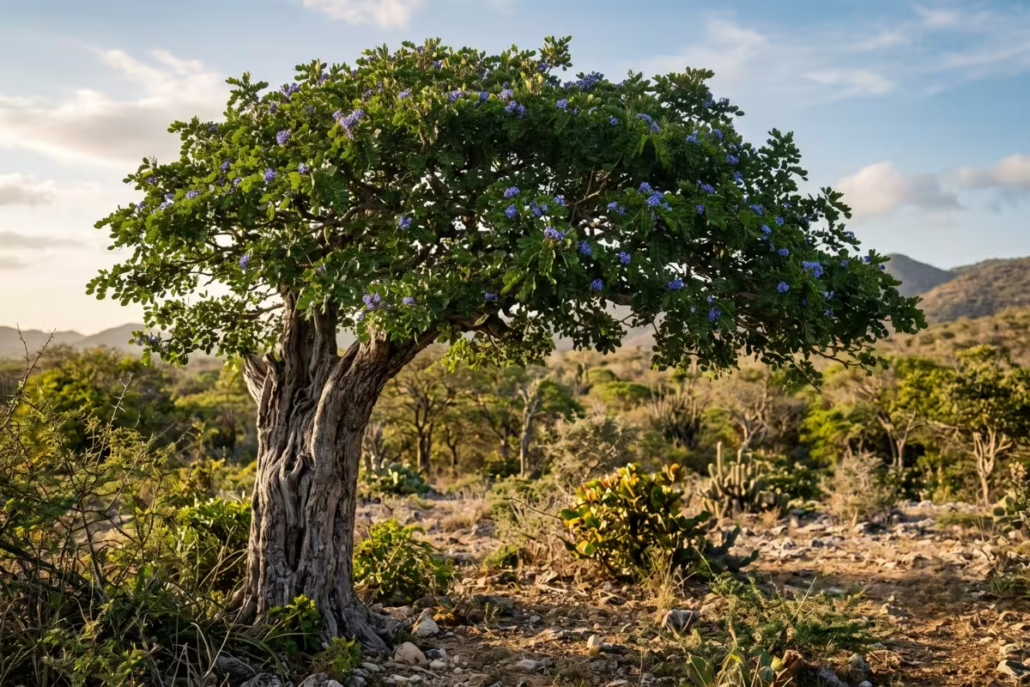 Lignum vitae tree
Photo: Glamorwood
Lignum vitae tree
Photo: Glamorwood
Lignum vitae blooms an ethereal blue.
Photo: Nature’s Vision, Turks & Caicos
Hartley Neita’s editorial in the Jamaica Gleaner (January 14, 2006) strikes the conservationists’ dissonant chord: one note of lamentation and three of alarm.
Neita writes that Jamaica’s “natural attractions,” even its national symbols, have nearly disappeared, “gone and forgotten except in the Tourist Guide Books of yesterday.” Among those vanishing is the Jamaican national flower, fragrant Lignum vitae, Guaiacum officinale. It takes a Caribbean environment to produce flowers this shade of purple-blue.
Gerald Singer writes that the lignum vitae tree produces “the heaviest and densest wood in the world.” So it has been a prized material in construction and invaluable for all manner of friction-bearing devices, everything from ship propellers, to gavels, to guitar picks. “Master clockmaker John Harrison used lignum vitae as the basis for his nearly all-wood clocks, since the wood provides natural lubricating oils which do not dry out.” Until plastic compounds began to replace this resinous wood (the 1970s), it was THE material for croquet mallets and balls.
According to Neita, lignum vitae used to cover Jamaica but now “only grows in Kingston and lower St. Andrew, and on the south coasts of St. Catherine, Clarendon, Manchester and parts of St. Elizabeth.”
That actually sounds pretty plentiful, no cause for concern, except that lignum vitae is actually disappearing all over the region: from Antigua (where it was cut down to make grinding parts for the island’s sugar mills) and from the Bahamas, where it also has “become scarce.” On St. Barth’s island, “the Gaiac, as it is locally called, is now a protected species.” In Florida, it has been “completely exterminated.”

Lignum vitae bowling ball created for pioneer bowler Catherine Menne in 1916.
Photo: International Bowling Museum
Lignum vitae (“Wood of Life”) also was harvested, somewhat notoriously, for medicinal purposes. It was said that in his voyages to the New World, Christopher Columbus picked up both syphilis and its cure: a concoction of lignum vitae (physicians and their patients soon discovered that the plant was palliative only).
To say the least, this plant has taken a human beating, and despite its durability, it now shows signs of defeat. Gerald Singer writes that in former days on St. John Island, “when someone’s problems were especially severe or when someone was carrying an extremely heavy emotional burden it was said that their troubles were ‘heavier than a Lingy Vitae cross.’”
Now that this indigenous tree has its own cross to bear, perhaps its beauty and strength will inspire people across the Caribbean to take up the cause of environmentalism, with conviction. In Barbados this past June, an island Environmental Society was formed. At the ceremony, Mo Watson called the natural world “the best psychiatrist….

Inaugurating the Barbados Environmental Society,
Liz Thompson and Maureen Watson plant a lignum vitae tree in honor of the late Colin Hudson, an environmental leader
Photo: Barbados Environmental Society
“Ask anyone who gardens, who sea-bathes, snorkels or communes regularly with nature in other ways, how the experience makes he or she feel. Take a look at that sight out there. Sights like this inspire our hearts, minds and soul with wonder, gratitude, occasional unselfish reasoning and love. We ask ourselves why don’t we do it more often. Imagine it disappearing before your very eyes. And you being the last generation to enjoy and connect with the natural beauty of our Island.”
The Barbados group birthed its organization by planting a lignum vitae tree. Lovely. Here, as in Jamaica, it’s time to play hardball.
(Originally published: HFP January 14, 2006)
Update: In 2006, it looked like Caribbean conservationists were determined to restore this treasured tree to the islands, but nothing much seems to have changed! We know lignum vitae is a slow grower, only 1-3 inches per year, but after two decades, there should be a lot of 4-5 foot trees well on their way to maturity.
This recent article from the Jamaica Gleaner sounds the same alarm bells that Hartley Neita rang twenty years ago: that harvesting has continued and the lignum vitae remains in decline.
“The National Environment and Planning Agency (NEPA), Jamaica’s agency responsible for promoting sustainable development through the protection of the environment, regulates the cutting and export of the plant and a permit is required to export any part or products made from it. Illegal trading can result in fines up to $2 million or two years imprisonment – or both – in a parish court, alongside product confiscation.”
But apparently the regulations on the books haven’t been enough to deter harvesting and urban development on the land.

Young trees – Lignum vitae grows slowly, only 1-3 inches per year.
Photo: What’s Going On, St. Thomas
That same agency found two years ago “a reduction in the presence of lignum vitae over time, reinforcing trends observed in the 2007 assessment and suggesting that the pressures affecting the population have persisted over the last two decades.”
Sashana Small of the Gleaner interviewed Liggi Days of the Ocho Rios Crafts Market. His assessment: “Jamaican Government just too reluctant when it comes to certain things, the important thing to the culture of Jamaica. The Government too reluctant ‘bout dat.”
A reluctance born of what? If we were talking about the U.S.A. we’d say — born of government collusion with the harvesters and developers. Jamaican readers, what say you ’bout dat?


Leave a Reply